previous names: Portola Plumas (1922)
Home Port: Baltimore, MD
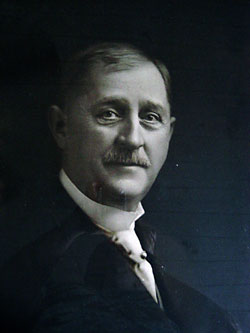
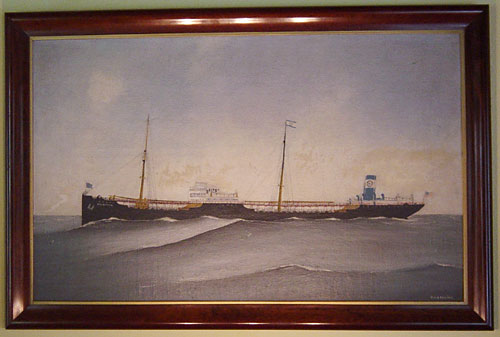
W.E. Hutton and ship painting (Courtesy of his great, great grandson, James Hutton)
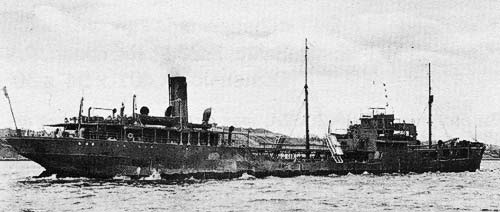
W.E. Hutton (Moore)
 |
|
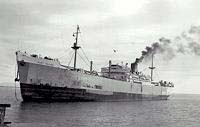
Port Halifax, 1937
|

| SHIP NOTES: (Sources: Jordan, Gentile) | |||
| Name: W.E. HUTTON previous names: Portola Plumas (1922) |
Type: Tanker | ||
| Built: 1920 by Bethlehem Shipbuilding Corporation; Alameda, California | Owner: Pure Oil Company Home Port: Baltimore, MD |
||
| Size (ft.): 453-0 x 56-0 x 27-3 | Gross Tonnage: 7,076 tons | ||
| Propulsion: Single screw reciprocating steam engine/speed 10.0 knts | |||
| Date Sunk: 3/18/42 | Cause: Torpedoed by U-124 | ||
| Location Cape Lookout, NC | GPS: N34° 29.990'/W76° 53.879' | ||
|
|
|||
| SHIP HISTORY: (Sources: Moore, Hickam, Gentile) | |||
|
|
||
|
W.E. Hutton and ship painting (Courtesy of his great, great grandson, James Hutton)
|
|||
|
|||
|
W.E. Hutton (Moore)
|
|||
The W.E. Hutton was traveling from Smith's Bluff, TX to Marcus Hook, PA with 65,000 barrels of #2 heating oil. Inspite of the u-boat threat, she was traveling unarmed and alone, but her master, Captain Carl Flaathen, had taken the precaution of running with lights out and black-out curtains engaged. But against a shrewd and experienced u-boat captain like KL Mohr of the U-124 this was not enough. At 2210, on 3/18/1942, a torpedo slammed into the bow, on the starboard side blowing out the forepeak. The Hutton started listing to the starboard side, but was staying afloat and making headway. The captain made the decision to try to make ashore where he could beach his wounded tanker. Eight minutes later, the U-124 launched another torpedo, this time with greater affect. It slammed into the port side at the #3 tank right below the miship house. The Hutton's midships quickly became a blazing inferno. Rafts and lifeboats were launched as the crew started abandoning the stricken tanker in order to escape the flames. At 2245, with its captain watching from a lifeboat, the W.E. Hutton sank bow first in the 70 feet of water. Although spread across two lifeboats and two life rafts, the 23 survivors had the good sense to stay together during the night. At dawn of the 19th, the all gathered into one lifeboat and started rowing their way to shore. They were picked up at 1035 by the MS Port Halifax and taken to the Savannah, GA sea buoy where they were transferred to a pilot boat and taken ashore. 13 crew were killed in the attack.
| |||
|
|
|
| DIVING NOTES: | |
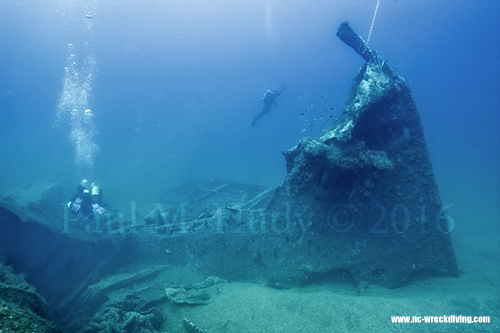
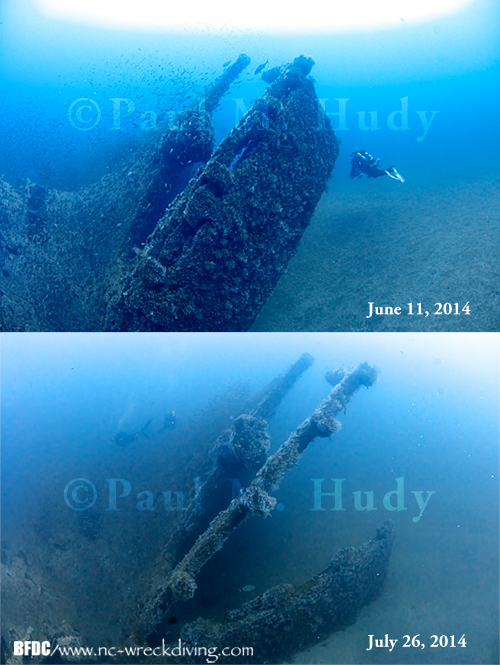
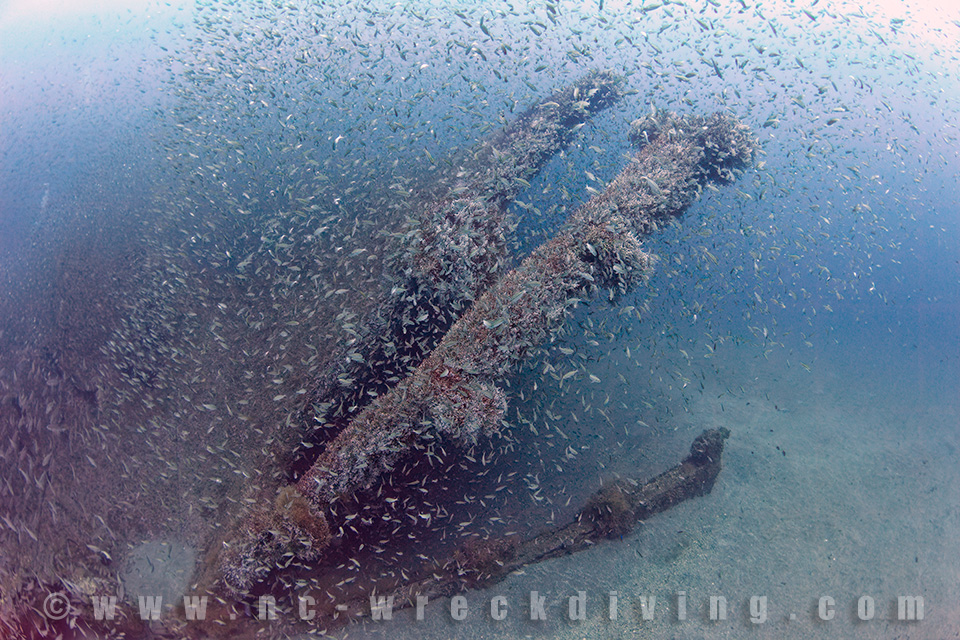
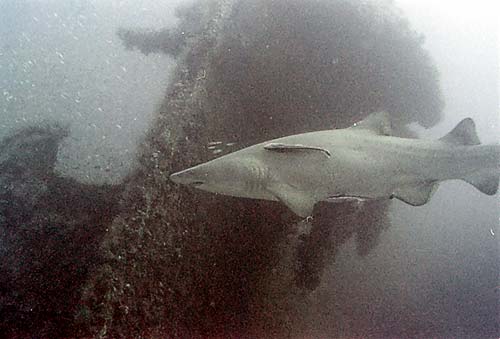
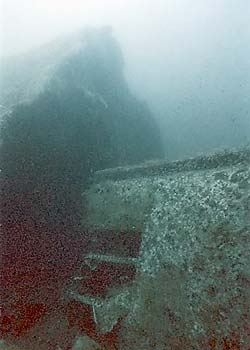
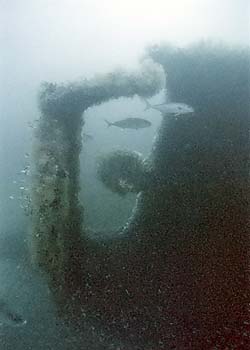
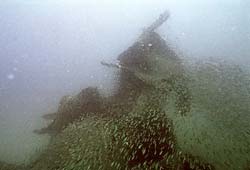
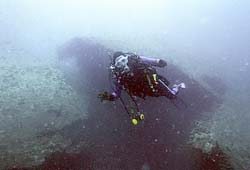
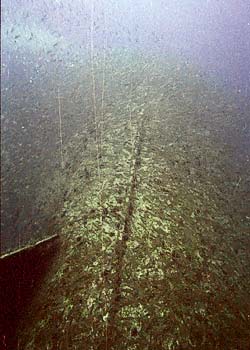
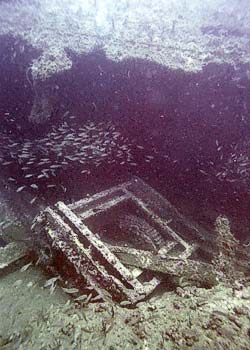
| Diving Depths: 90-120 ft. Visibility: Generally very good; range 50 to 100+ ft. Current: Slight to strong Summer Temperature: high 70s to lo 80s Points of Interest: Large rudder, bow anchors. Fish/Animal Life: The usual array of offshore NC marine life and has been a fairly consistent source of large groups/schools of sand tiger sharks. In addition to the sharks, over the years, I have spotted manta rays, jewfish and other unusual sightings here. Description: For many years, the W.E. Hutton wreck site was mis-identified to be that of the Papoose. This was finally corrected in 2006 by several teams analyzing the wreck but old habits die hard and many folks still refer to this site as the Papoose. To add even more to the confusion, and inshore wreck, the Ario used to be mistakenly thought to be the W.E. Hutton. Many still refer to the inshore wreck as the W.E. Hutton. Confused yet? Well, this all has an even bigger ripple effect: The new wreck "identity" scenario which blows-up a number of decades- other old wreck locations and identifications. This is how it stands today: W.E. Hutton site is really that of the Ario. And the site of the Papoose is that of the W.E. Hutton. So where is the wreck site of the Papoose? In this hypothesis, it is the wreck site previously thought to be that of the San Delfino, well north of Hatteras over 50 miles a way. And the San Delfino? It is the located at the site locally thought to be the Mirlo, another large tanker sunk by the U-117 during World War I. The new location of the Mirlo is yet to be identified. W.E. Hutton — 453-0 x 56-0 x 27-3 — Sunk: 3/18/1942 Papoose — 412-0 x 53-4 x 25-8 — Sunk: 3/19/1942 Ario — 435-0 x 56-0 x 31-0 — Sunk 3/15/1942 San Delfino — 463-0 x 61-0 x 33-0 — Sunk: 4/9/1942 Mirlo — 425-0 x 57-0 x 33-0 — Sunk: 8/16/1918 The WE Hutton is a large wreck which sits on the bottom mostly connected and intact and upside down. Over the decades, the once continuous hull (imagine a water melon cut in half laying on the bottom) has developed cracks and collapsed and twisted into more distinct parts. At one time, back in the 1960's, the wreck was actually sitting on its port side, but over the years the wreck has rolled, crushing the superstructure under the weight of the hull. The highest part of the wreck is in the stern rudder area which rises some 30 feet off of the bottom. In 2014, the rudder blade broke away from the stern and fell into the sand. It is quickly being buried by the shifting sands with only about 1/3 remaining visible as of 2016. The propellor was present until the mid-1970s when it was blasted off by salvagers. The hull section steps down from there in several large sections, each lower than the other, until you come to the bow. The bow point is laying in the sand with anchors still in the hawse pipes. The Papoose can be penetrated at several points. In the past it was quite eerie to see boilers and engines parts suspended above you, but when you look down, you see several of those same items laying crushed on the ocean floor. I believe these have all now fallen to the ocean bottom. [Diver beware!] The sharks seem to congregate at the ends of the wreck - particularly the bow - where the prevailing current, which sweeps across and over the top of the hull, creates eddy points. |
|
|
|
| PHOTOS & VIDEOS: | |
|
|
|
|
Video tour around the wreck (2013)- from stern to bow and back
|
|
 |
|
|
The bow and one of the bow anchors
|
|
 |
|
|
The stern - before and after the rudder broke free
|
|
 ] ]
|
|
| Rudder blade slowing being covered by sand (August, 2017) | |
 |
|
|
Sandtiger shark swims in front of the bow anchor
|
|
 |
 |
|
Breaks in the upside down hull
|
The rudder, propeller shaft at stern
|
 |
 |
|
Remains of the bow
|
Diver swims along upside down hull
|
 ] ]
|
|
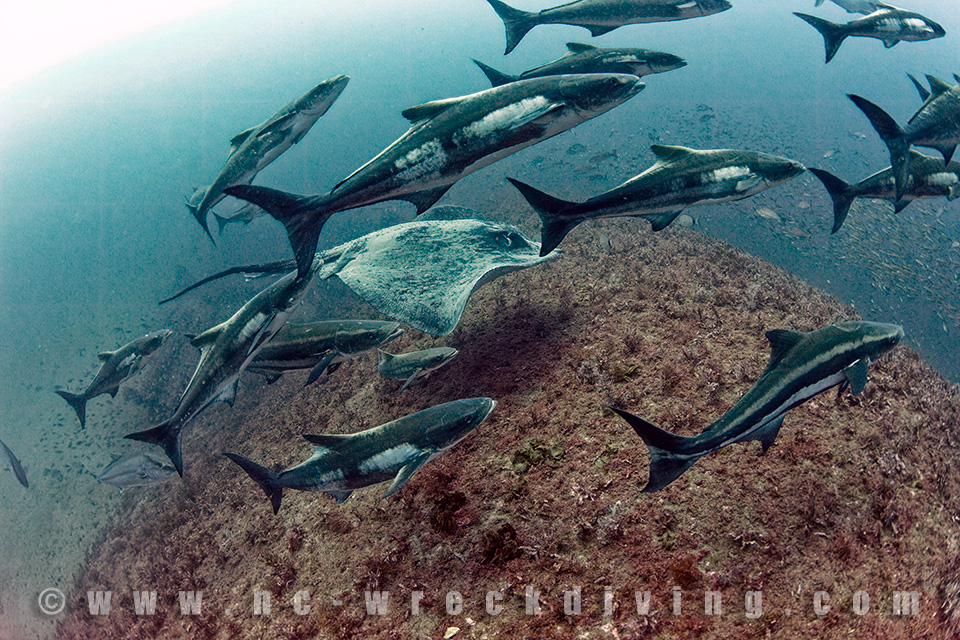
| Procession of cobia leading a southern sting ray over the hull of the W.E. Hutton | |
 |
 |
|
The featureless surface of the hull botton
|
Part of the deck/superstructure
crushed under the upside hull |
Unless specifically noted, all photos, text and content Copyright © Paul M. Hudy